
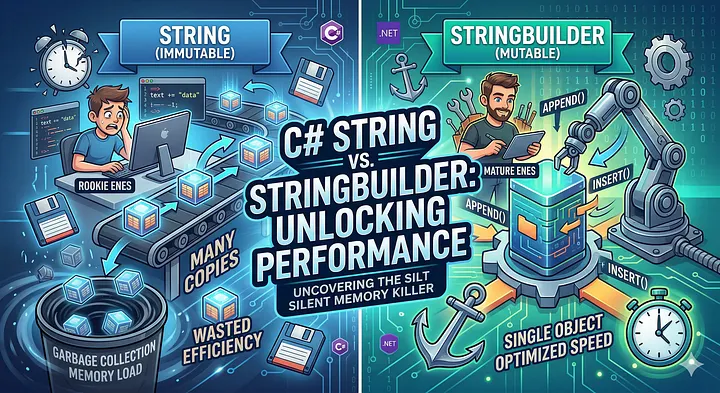
Since my early days at university, professors and online resources always gave me the same advice: "Just use String; it’s easier." And for a long time, I did. I treated string as a loyal friend, unaware of what was happening behind the scenes in the memory.
That was until I met StringBuilder.
Meeting StringBuilder forced me to look back at primitive data types with a fresh perspective. Not with the "rookie" eyes of young Enes, but with a systematic and analytical approach. Here is what I’ve learned about the silent battle between these two C# giants.
The Truth About Immutability
In C#, a string is a reference type that mimics a value type. Its most defining characteristic is that it is immutable (unchangeable).
What does "unchangeable" actually mean? Imagine you have a loop with 1,000 iterations, and in every step, you add a word to a string variable.
string text = "";
for(int i = 0; i < 1000; i++) {
    text += " data";
}
At the end of the loop, how many string objects are in memory? One? No. There are 1,000 string objects.
Because strings are immutable, every time you use +=, C# doesn't modify the
existing string. Instead, it creates a brand-new copy in the memory (Heap) and discards the old
one. While the Garbage Collector (GC) eventually cleans these up, you are essentially putting a
massive, unnecessary load on your system's performance.
Memory Insight
String immutability is great for thread safety and interning, but it's a disaster for frequent concatenations in loops.
Enter StringBuilder: The Architect
Unlike string, StringBuilder is mutable. It works on the same object in memory. Whether it’s the 1st or the 1,000,000th modification, the object stays in the same place. It simply expands its internal buffer as needed.
So, is the classic String "trash" now?
Absolutely not. In software engineering, there are no absolute perfections—only trade-offs.
StringBuilder is a reference object, meaning you must instantiate it using the new
keyword. For small, simple operations, string is actually faster and more memory-efficient
because it avoids the overhead of object creation.
Comparison: String vs. StringBuilder
The "Char Array" Misconception
You might hear some developers say, "A string is just an array of chars." While it
looks that way from the outside, the reality is different. A char is a value type; it is
mutable. You can easily change an element in a char[]. However, you cannot do that
with a string. In C#, a string is a sealed, immutable block of data.
If you need to manipulate characters individually at high frequency, consider using a
char[] or Span<char> before converting back to a string.
Conclusion
If you are just concatenating two or three words, stick with string. It’s cleaner, more readable, and perfectly fine for the Garbage Collector. But if you are inside a loop, building a large JSON, or processing heavy logs, do yourself (and your memory) a favor: Use StringBuilder.
Best Practice
Measure, don't guess. For most business logic, String is fine. for hot paths and loops, StringBuilder is your best friend.